



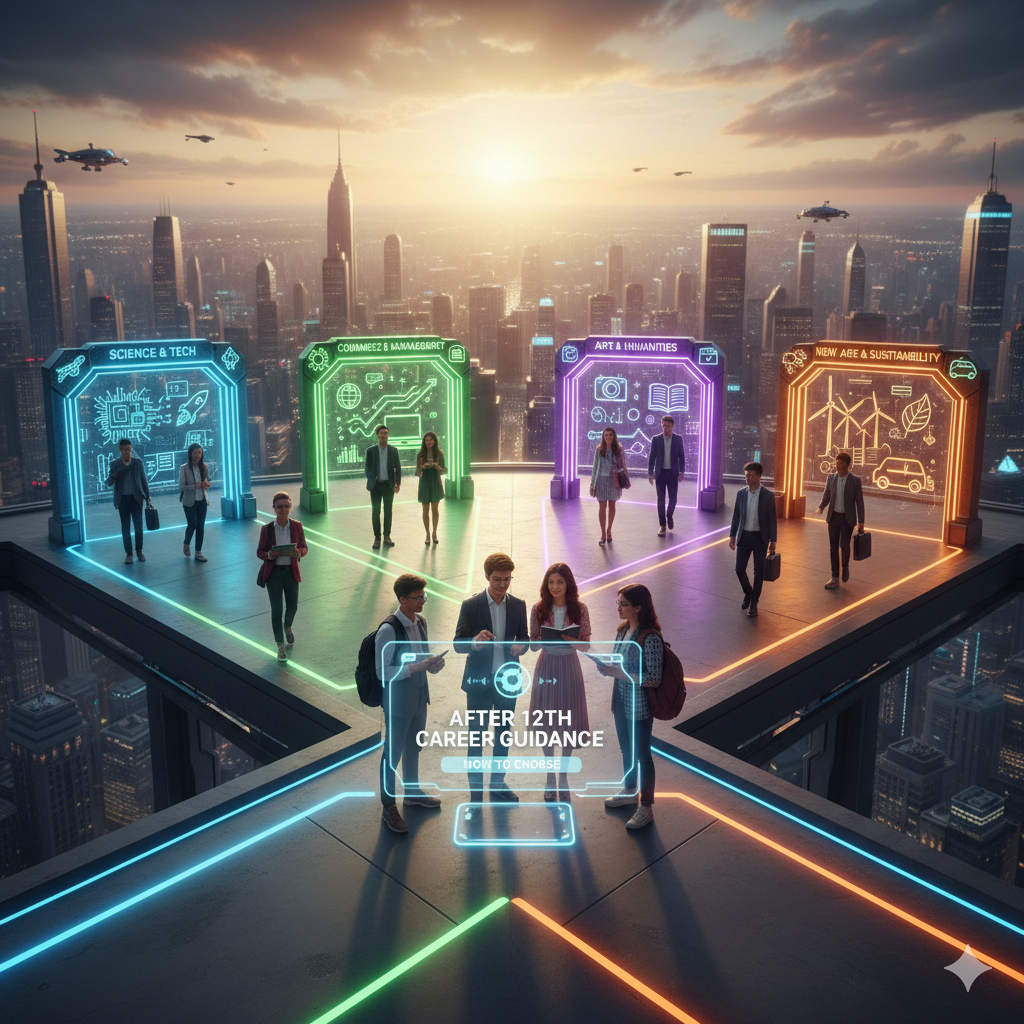
The moment you finish your 12th-grade boards, the world stops asking "What are you studying?" and starts asking "What are you becoming?" In today’s economy, the answer isn’t always a single job title—it’s a set of skills.
Whether you come from Science, Commerce, or Arts, the boundaries between these streams are blurring. Here is how to navigate the modern career landscape.
The days of choosing only between a stethoscope and a hard hat are over. While engineering and medicine remain foundational, the most exciting growth is happening at the intersection of technology and biology.
The Rise of Bio-Digital Convergence: With the explosion of health-tech, Bioinformatics has become a powerhouse field. It’s where biology meets big data to solve complex medical puzzles.
The Green Tech Revolution: If you care about the planet, Sustainability Engineering and Renewable Energy Systems are no longer niche—they are the backbone of the 2020s industrial shift.
The Deep Space Aspirations: For the purists, a B.Sc. in Physics or Chemistry is the first step toward high-level research. Space agencies like ISRO are increasingly looking for specialists in Astrophysics and Material Sciences to power the next generation of lunar and Mars missions.
Commerce has evolved from simple accounting to complex ecosystem management. It’s about understanding how value is created in a digital-first world.
The Management Launchpad: A BBA is no longer just a "pre-MBA" degree. In 2026, specialized BBAs in Data Analytics or Digital Entrepreneurship provide immediate market value.
The Financial Engineers: Beyond CA and CS, look into FinTech Management or Quantitative Finance. These roles use mathematical models to predict market shifts, making them some of the most lucrative in the corporate world.
The "starving artist" is a relic of the past. Today, the most successful companies are built by people who understand human behavior, aesthetics, and communication.
Human-Centric Design: As AI handles the "logic," humans are needed for the "feeling." UI/UX Design and User Research are critical for every app and service we use.
The Psychology Surge: We are in a global mental health era. Pursuing Psychology or Behavioral Economics opens doors in corporate HR, clinical practice, and even AI development (teaching machines how to interact with people).
Modern Storytelling: Journalism has transformed into Content Strategy and Transmedia Storytelling, where you manage a brand's voice across VR, social media, and traditional platforms.
Don't build your life on a "2010 blueprint." The world moves faster now. To stay relevant:
Prioritize Agility over Stability: Don't just ask "Is this job safe?" Ask "What skills will I learn here that I can use elsewhere?"
Follow Curiosity, Not Just Trends: A high-paying career that bores you will lead to burnout by age 25. A career fueled by genuine interest feels like a series of puzzles you want to solve.
The "Multi-Hyphenate" Advantage: You don't have to be just one thing. You can be a Programmer-Designer or a Marketer-Psychologist. Hybrid roles often pay the best because they are the hardest to fill.
Your first degree is a foundation, not a life sentence. Many of the world’s most influential leaders changed their "major" multiple times before finding their groove. Take the pressure off—choose the path that makes you want to keep learning.
